
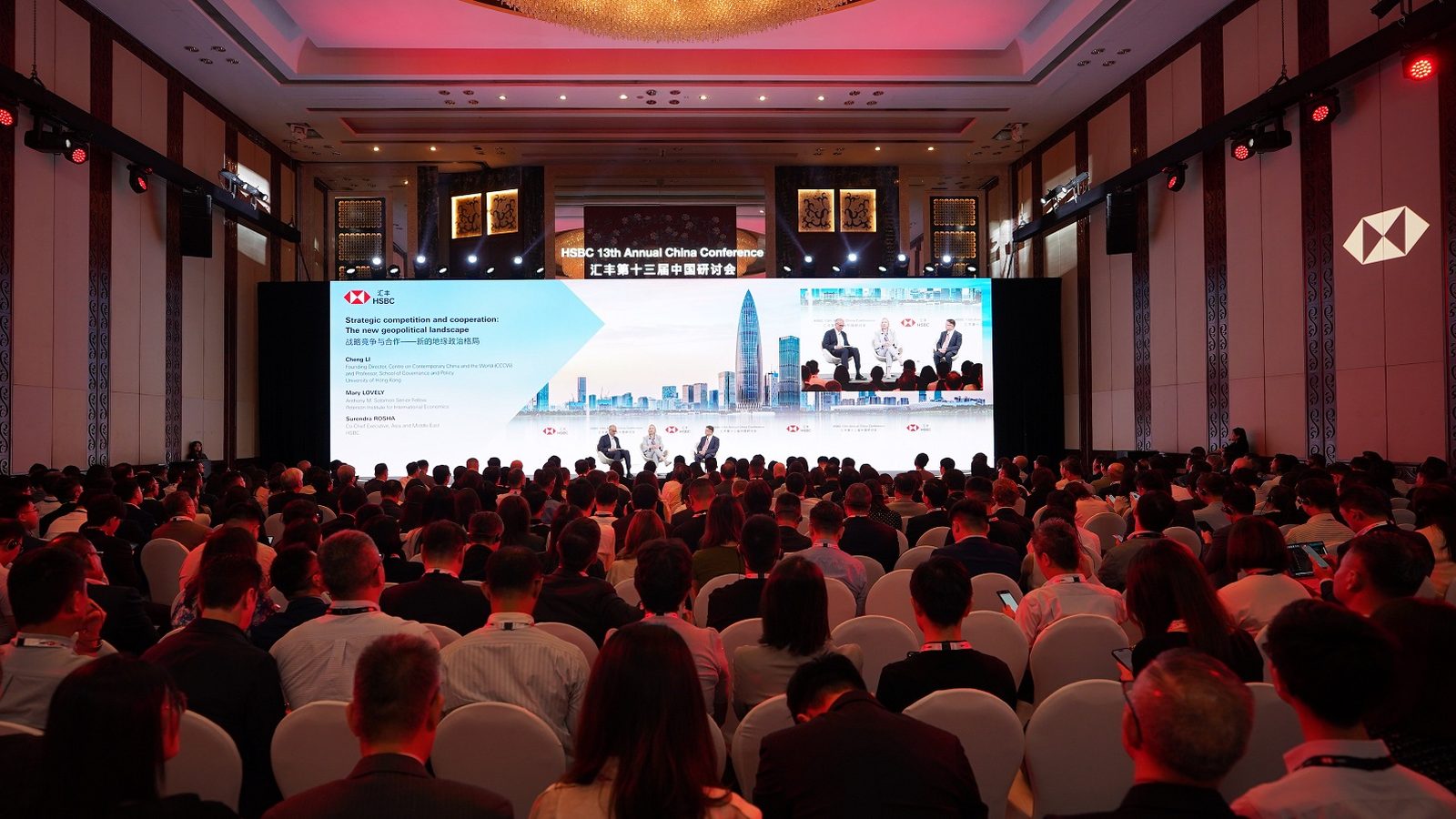
HSBC’s Annual China Conference explores the next chapter of growth
More than 1,500 investors, business leaders and policymakers explored the trends and opportunities shaping China’s next chapter and global growth, at HSBC’s 13th Annual China Conference.
The conference, held in Shenzhen on 1 and 2 September 2026, heard from 50+ experts on topics including the state of the global economy, US monetary policy, international trade, investment trends and the latest technologies altering the way we do business across geographies.
We facilitated approximately 2,000 meetings among nearly 140 companies across a range of sectors: technology/media/telecommunications, financial, real estate, utilities/energy, consumer, healthcare, automotive, chemical, and logistics were all represented.
For additional sector-specific insights, business leaders had direct access to our Global Investment Research analysts and economists, and the opportunity to attend breakout sessions.
China’s key opportunities
In his opening address, David Liao, our Co-Chief Executive, Asia and Middle East, said: “Since last year’s conference, the pace of change has remained blistering.
“This year’s conference agenda has been designed to support your planning and decision-making across funding, trade, and investment.”
He outlined three key areas of opportunity in China:
- Energy security and electrification
- Offshore renminbi, as firms manage funding and FX risk
- Hard tech - AI, robotics, biotechnology and advanced manufacturing
AI was front and centre of discussions, with the sector’s competitiveness described as a two-horse race between the US and China. While the US leads on some frontier innovation, China is the powerhouse in applying AI at scale and building domestic models quickly, the conference heard.
In a moderated session on geopolitics and supply chains by Surendra Rosha, our Co-Chief Executive, Asia and Middle East, panellists said supply chain diversification was necessary, in the face of challenges and costs, for a healthy global economy.
“Look to the longer-term strategic interests of both US and China,” said Mary Lovely, Anthony M. Solomon Senior Fellow, Peterson Institute for International Economics. “Do an inventory of your own asset base and think about those assets beyond capital – include services and talent – and how they can be deployed flexibly if circumstances change.”
On the China-MENAT corridor, speakers reflected on the fact that trade between the two has increased more than 20-fold in the last five years – reaching US$500 billion in 2025 and surpassing the trade flow between China and the US.
While fuel exports and large-scale infrastructure have dominated traditionally, newer sectors related to the energy transition, AI and consumer retail have emerged, delegates heard.
Global trade as a topic was revisited throughout the conference, where China’s dominance was underscored. China accounts for nearly 40% of global trade containers and for the world’s 5-7% trade growth in the last few years, according to panellists.
Foreign corporates intending to expand in China were encouraged to partner with Chinese companies, not only to gain Chinese capabilities, technologies and research but to also access the ‘Global South’ in a cost-effective way.
China’s emerging opportunities
On day two of the conference, Mark Wang, Chief Executive Officer, HSBC China, spoke about further opportunities emerging in China from three megatrends:
- Innovation – specifically within the AI ecosystem and pharmaceuticals
- A new generation of ‘global-born’ middle-market companies exporting products, technology, brands and business models
- A maturing wealth landscape that’s moved beyond creating wealth to preserving it, growing it across generations and allocating it globally
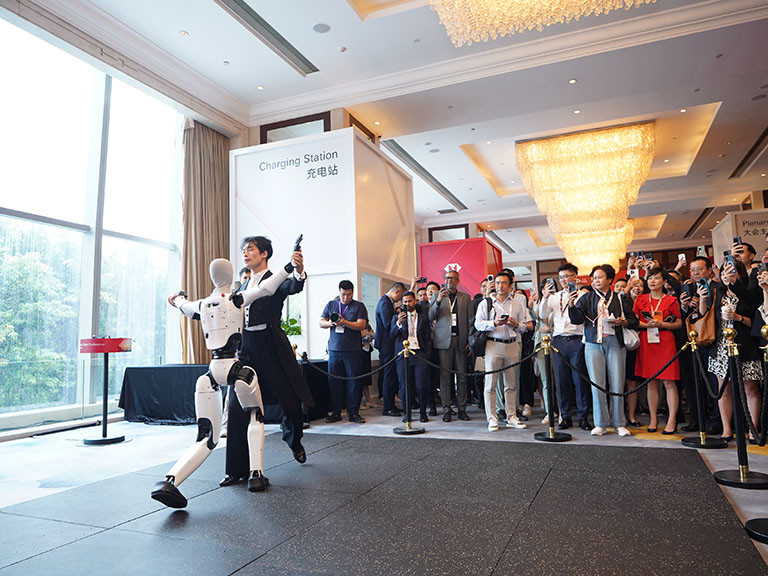
One major innovation – robots and their potential applications – fired up imaginations. Founders of robotic companies shared how these intelligent machines are being explored for education, with robotic labs in schools, and for their potential use as at-home tutors.
They also discussed potential use cases in hazardous environments to conduct inspections, collect data and even direct traffic.
Will we see general purpose humanoid robots in the near future? They’re expected to go through several iterations, much like mobile phones and electric vehicles, the speakers said, and use-case development should focus on strengthening a single, practical capability from simple to complicated environments.
Throughout the event, there was overall consensus that China continues to be one of the world's most important drivers of growth and innovation.
“It’s next phase of development will be driven by technological advancements, a strong domestic market and a greener economy,” said Mark.