

Testing our tech
Our user research programme has one mission – to make sure that our products and services are accessible for everyone.
While this approach benefits all our customers, it’s crucial for those with sensory and physical disabilities or neurodivergent conditions.
To some, creating digital accessibility for all might seem like a big challenge, but to our user researchers, it’s all in a day’s work.
Inclusive approach
We’ve been working with AbilityNet (opens in new window) (opens in new window) (opens in new window) (opens in new window) to deliver dedicated accessibility user research since 2021.
Each year, we run an ever-increasing number of user research projects, where customers and non-customers test our online and mobile products and services.
Users who rely on assistive technology, such as a screen reader, screen magnification software or voice input are active participants in the programme. Their feedback shapes the design of future products and also helps us to meet – and exceed – our accessibility standards.
It’s essential work that will help us achieve our aim of being the world’s most digitally accessible bank.
Putting our customers and colleagues first
The programme started in our home markets of the UK and Hong Kong.
We’ve already widened the scope to a number of other markets, including Singapore and India, and we have ambitions to roll it out further.
In line with our broader accessibility strategy, the research covers all areas of the business and it shows that we’re already leading the way.
By early 2026, we had completed projects that have improved digital accessibility across retail banking, business banking and our colleague-facing systems.
“Research helps us understand how our customers need and want to interact with us, which brings so much value to what we do,” said Dr Chris Bailey, a Senior Digital Accessibility Manager at HSBC, who leads the programme.
“It’s also a rewarding and informative experience. The insights we gain feed back into our wider thinking on accessibility, help us evolve our strategy – and are a great example of how we’re opening up a world of opportunity.”
Mobile interaction
We’re also working with the bank’s Design Research team on the redesign of our mobile customer experience.
This collaborative approach has enabled us to test visual designs and interactive prototypes, to improve the look-and-feel and overall navigation – and to ensure that new, interactive features work well for everyone.
So far, we’ve tested builds prototypes of the latest version of our app in the UK, Hong Kong and Singapore – and we’ll continue this work, as our new mobile customer experience goes live in other markets.
User testing doesn’t stop when a product launches, it’s an ongoing process.
Recent research in the UK, for example, told us that our customers wanted more information about their transactions, within the app.
With this feedback in mind, we updated the transaction details page and it now includes location information for card transactions and a map, showing where purchases were made.
We’ll continue to develop our user research programme – and ensure that all our customers with accessibility requirements are represented in the design and development of our products and services.
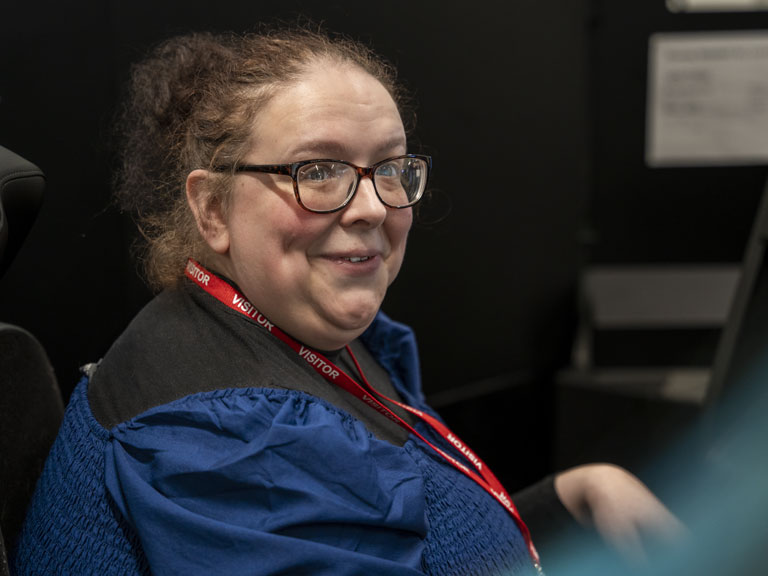
Inside the test cell
Our products go through the ultimate accessibility test – real people. Three users with different needs put our new ATMs through their paces.
Content last updated: 7 May 2026