
We’re becoming a simple and more agile bank
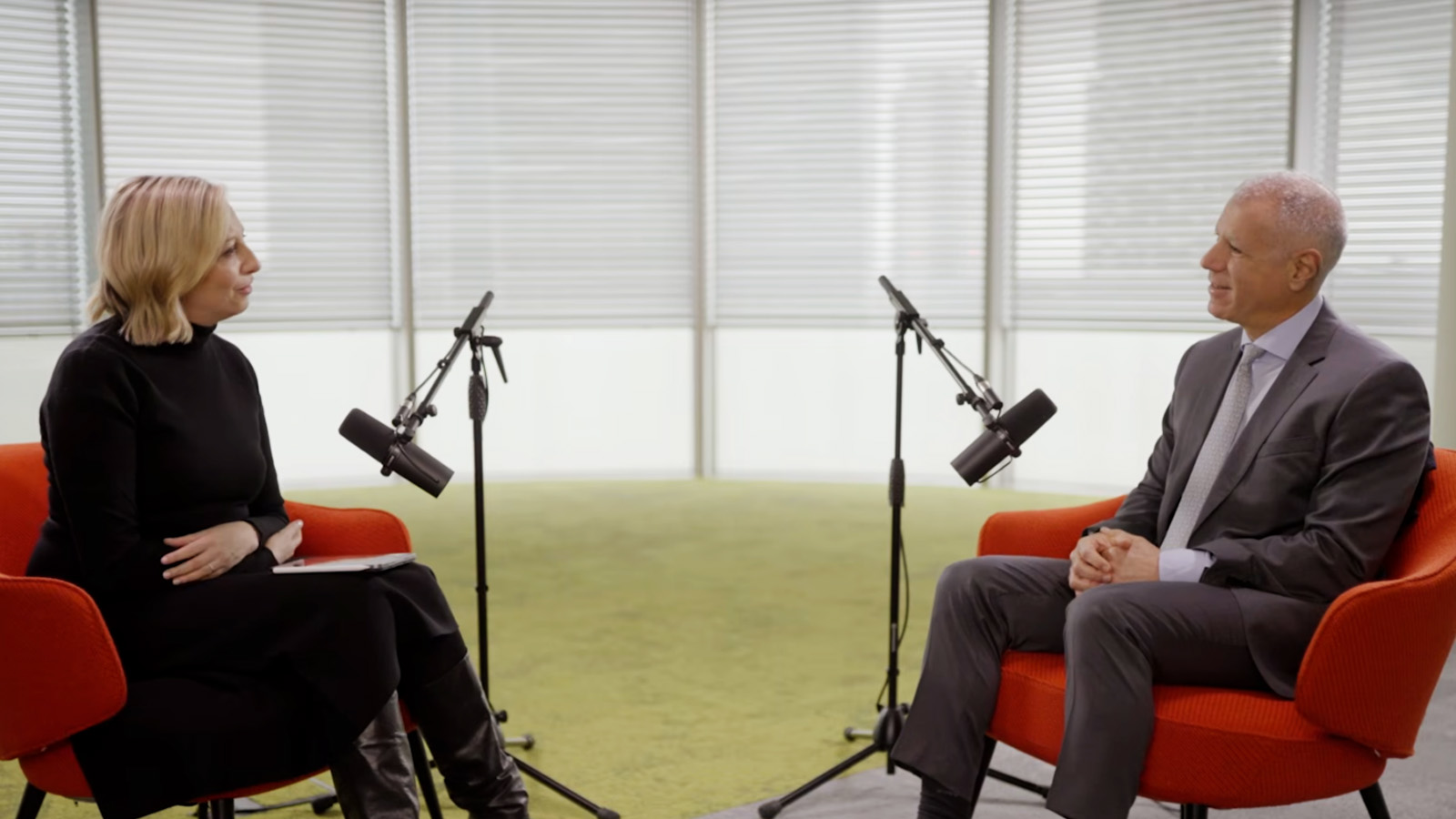
In an interview with Francine Lacqua at Bloomberg, our Group CEO, Georges Elhedery, talked about leadership, how he’s creating a more simple and agile bank that’s built for the future – and the role AI will play.
Georges Elhedery on leadership
Duration: 00:06:19
Speakers:
- Georges Elhedery, Group Chief Executive, HSBC
- Francine Lacqua, Anchor and Editor-at-Large, Bloomberg TV
LinkedIn (opens in new window)
[Francine]
I’m Francine Lacqua, and this is “Leaders,” the podcast that explores what drives the world’s most influential minds.
Joining me this week is Georges Elhedery, the Chief Executive of HSBC, one of the world’s biggest banks.
He’s been in the top job since September of 2024, and not shied away from difficult decisions, including a huge restructure, slashing thousands of jobs.
[Text on screen]
Bloomberg
HSBC’s Job-Slashing CEO Pivots to $14 Billion Hong Kong Bet
Harry Wilson, Manuel Baigorri, Denise Wee and Ambereen Choudhury | Oct.9, 2025
[Francine]
While some might consider his methods ruthless, HSBC’s share price has responded positively.
It’s roughly doubled to a record high since Elhedery took over.
[Text on screen]
Bloomberg
HSBC Shares Surge to Record on Profit Beat, Raised Targets
Harry Wilson and Ambereen Choudhury | Feb.25, 2026
[Francine]
And after an eventful first year, I wanted to catch up with him and dig into those management decisions, understand how he’s evolved as a leader, and hear how he’s thinking about AI.
[Text on screen]
Francine Lacqua
Anchor, Bloomberg Television
LEADERS
with Francine Lacqua
The Podcast
[Francine]
Georges, thank you so much for speaking to us.
[Georges]
Great to be with you, Francine.
[Francine]
We were counting how many languages you spoke. Eight?
[Georges]
So I’ve studied eight languages.
[Text on screen]
Georges Elhedery
CEO, HSBC
[Georges]
Other people should judge if I speak them.
[Francine]
Do you have a love for languages?
[Georges]
I’m fascinated by language.
[Francine]
Because?
[Georges]
Because if you’re fascinated by cultures, then you’re fascinated by understanding how they think, and how they express themselves.
And that basically naturally links you to understanding their language.
[Text on screen]
Licensed to HSBC for display until 29 March 2027 on company website, intranet and approved social channels only.
[Francine]
Can you only be a good leader if you understand people?
[Georges]
I think you have to definitely listen.
And if you can listen in their own language, then even better.
[Francine]
You grew up in Lebanon?
[Georges]
Yes.
[Francine]
And what was your early childhood like?
[Georges]
So I grew up in Lebanon.
I have, at age 18, I moved to France for my university.
I then picked an internship in Germany, and by coincidence, I ended up doing an internship in banking.
So, I went back to Paris to finish my postgraduate degree in finance, statistics and economics.
Because I enjoyed it, of course.
And I picked up my first job in Japan.
And then back to London at that time, up until the time where HSBC hired me, and that was exactly 20 years ago.
[Francine]
At the time you wanted to be an engineer. So, what attracted you to finance?
[Georges]
So I absolutely wanted to be an engineer.
I studied as an engineer, and as you know, back to your question about languages,
I had studied German for about 10 to 12 years at that time.
So, I went to do an internship in Germany.
The only internship I managed to land was an internship on the trading floor in Frankfurt.
So, I took it, and then I got addicted to it.
[Francine]
What did you like about it?
[Georges]
I like the pace.
I like the still, at that time, remember there’s a lot of financial engineering, so you're still using a lot of your engineering skills.
It still happens, right?
And then all sorts of, it’s highly transferable to finance.
I liked the accountability, I liked the early responsibility you can get.
So, that’s where it started.
[Francine]
Georges, did you always want to be a leader?
Were you a leader as a child?
[Georges]
It’s difficult to define what a leader is, especially if leader a child.
If it’s a matter of living up with high standards and high values and high integrity, and being able to project that around you, then yes, that started very early with me.
But there are certain traits in leadership that really resonate with me.
The first one is you lead by example.
You walk the talk, you demonstrate that things apply to you as they would apply to anybody else that you expect them to be applied to.
And you don’t never make an exception for yourself.
[Francine]
When you look at leadership, how does, I guess the young formative years give you a sense of who you will become?
[Georges]
You learn and you feel what is right, and what is not right.
And a number of people around you, including my direct family, my parents, it kind of formed part of how you think and what ethical standards you set yourself and the integrity by which you operate.
And then sometimes around you, you feel things aren’t right, or aren’t fair, and it’s very important to stand your line, to hold your line.
[Francine]
That’s difficult. How do you do that?
[Georges]
It is difficult. Discipline.
It’s very important to hold the discipline.
And it’s very important to think of yourself as your own brand.
If you want your own brand to remain the brand of integrity, then it’s very important you stick to it.
[Francine]
I’ve heard, I mean, some chief executives see it as, they decided from very early on who they did not want to be.
Is it choosing who you do not want to be?
Or who you want to be? What’s easiest?
[Georges]
I think both go hand in hand.
It’s very important to realise who you want to be.
And by comparison, realise also, what are the traits you absolutely do not appreciate, do not regard, and therefore that you want to stay away from.
[Francine]
Talk to me about your, I guess your favourite pre-CEO job at HSBC.
Do you have a place in the world where you really kind of had to hone in on your leadership skills and understand the culture?
[Georges]
I’ve spent 20 years at HSBC now.
And there isn’t a single geography on the planet where I spent that long.
So, there is a sense of belonging for me to HSBC that supersedes any kind of physical attachment to any place.
I mean, with HSBC, I’ve been, I don’t know if I can count now, however many dozens and dozens and dozens of times, probably hundreds, to places like Hong Kong, one of the two HSBC home markets, the Middle East, where I spent many years for HSBC, specifically in Dubai, but also roving around the whole of the Middle East.
Europe, of course. The US, the Asia, as a whole.
It’s just amazing the opportunities you have to get there.
And every time you’re there, you spend time, you create more connections, you have an even deeper understanding.
I mean, if I ask, I bring 10 people in the room, and I ask them how many geographies they work for, for HSBC, you would find people who tell you more than 10.
That kind of experience, frankly, is unique.
© HSBC Group 2026
During the discussion, recorded in December 2025 as part of Bloomberg’s Leader podcast series, Georges reflected on how he started in banking, his 20-year career at HSBC, how “humbled and honoured” he was to be appointed as Group CEO and the actions he’s taking to remove complexity.
“There’s massive potential in this bank,” said Georges. “Some of it needed to be unleashed. It needed to be unlocked.”
Georges Elhedery on simplifying HSBC
Duration: 00:05:54
Speakers:
-
Georges Elhedery
Group Chief Executive, HSBC -
Francine Lacqua
Anchor and Editor-at-Large, Bloomberg TV
LinkedIn (opens in new window)
[Francine]
So, Georges, talk to me about when you get the call that you've, you know, been appointed chief executive, what's your first thought?
[Georges]
Of course, the first thought is to be humbled and honoured for being given this fantastic responsibility, but what really mattered for me is what I can do for this bank, not who I was or what my title was in this bank.
Now, it so happens there's a lot you can do as a group CEO in terms of effecting change or effecting, you know, bringing potential to the bank, so it was therefore the great kind of opportunity for me to be able to do what I really set out to do and what I had the full support of the board to do.
[Francine]
But you moved fast, right?
You got appointed and then you actually said,
Does the chief executive need to move fast, to kind of say, right, this is the change and this is what we need to be, and is it all on you or did you govern by consensus?
[Georges]
So, a few things on that, Francine.
The first one is there is massive potential in this bank.
Some of it needed to be unleashed.
It needed to be unlocked, and some of that unlocking of the potential had to go through reengineering of certain of our aspects.
Reengineering the bank, rewiring the bank, so that we can unlock this potential.
Then having been in the bank 20 years, operating in a number of geographies and businesses and functions myself, I've built a lot of experience and a very large network of colleagues who have been also feeding their input and their concerns, which kind of forms a big set of kind of action book, if you want.
And then third, very importantly, I was already sitting at the board as a Group CFO before I took the CEO role, and all these conversations, I was having with my board, and if you have the support of the board, you, of course, you know, have the kind of right to be able to act quickly.
[Francine]
But what was the most difficult thing about that first restructuring plan because you have to get rid of units that maybe you're attached to, having worked here for so long.
There's, you know, people that you like that maybe you've had to move around.
Again, was it intellectual, or, you know, are you ruthless about it?
[Georges]
I was definitely ruthless about killing the complexity and the drag in the bank.
The most difficult part is when you have to separate with some of your colleagues.
I think we've been very thoughtful, we've been very considerate.
We've done it hopefully the right way and the most respectful way for the benefit, ultimately, of the firm and its customers.
You want it. You need it. We need it to be agile.
We needed it to be, you know, to be ready for the modern world, and to be that, we needed to be simple, and therefore, you know, kind of everything then drives what decisions you take from that mission statement.
[Francine]
How did the bank become so complex, and again, this is something that actually most organisations have to face as they grow.
I guess there's, you know, various factions, or a lot of companies actually could just become much more simple and simplified.
What did you see?
[Georges]
Entropy is a feature.
Entropy tends to increase, which means complexity.
If you do nothing about it, tends to increase rather than decrease, so things don't become complex by design.
They end up becoming complex by lack of focus, so bringing the focus at the simplification will allow you to start dealing with it.
That's the first observation.
Second observation is you have to be extremely methodical.
What has created the, you know, complexity?
How can it be addressed methodically?
Try to identify ways to be simple.
Some of the ways to be simple is to decide not to do certain things, and this is why we exited a number of activities.
The third thing is when you're taking structure decisions, you have to start from the top down.
You can't take structure decision from the bottom up.
This is why the first decision structurally that I've taken relates to simplifying the Group operating committee.
We moved from more than 20 people to about 12.
More importantly, we moved from 0% single accountability.
Everything had dual or multiple accountability to now about 60% of our revenue is generated under single accountability, so that's important.
And then the last thing, Francine, is to be patient because there's not going to be, we're not solving simplification overnight.
It's going to be a journey, and we have to be relentless at that journey, quarter after quarter, month after month, until we get the desired outcomes, and that journey is still on.
Like, we're not there yet.
[Francine]
But as a big chief executive of a big bank, you basically have, you know, the shareholders that you need to please, so simplification may be helpful, them understanding what the bank wants to become, you have your clients, and then you also have the employees, so how difficult is it to juggle these, you know, three masters?
[Georges]
So, there is one consideration, which, fortunately, the three masters align on, is being best at what you do.
Your customers want you to be the best at what you serve them with.
Customers, tick.
Your shareholders will pay you for what you're best at doing.
They won't give you valuation for something that you're average.
They will give you valuation for where you really command, where you're an authority in being able to provide that service or that product in that market, so the shareholders align to be the best, and then our colleagues want to be the best at, our colleagues want to win.
Our colleagues are in a competitive landscape and they want to win, and they basically thrive when we're delivering the best we can and when we're delivering best outcomes, and we're basically the best at what we do.
So, you know, you take this as a guiding thread and you say, "Let's focus on that.
Focus where we can grow in areas where we're the most competitively advantaged,” and then everybody aligns: colleagues, clients, and shareholders.
© HSBC Group 2026
Customer focus
When asked about the restructure, Georges said it had been done “in the most respectful way for the benefit ultimately of the firm and its customers”.
“The world is moving fast,” said Georges. “We need to move fast. Our customers are moving fast. Their needs today will be different tomorrow. Their goals today will be different tomorrow. And we need to be continuously adapting to their evolving needs and their evolving goals.”
Georges Elhedery on the future of HSBC and AI
Duration: 00:04:14
Speakers:
-
Georges Elhedery
Group Chief Executive, HSBC -
Francine Lacqua
Anchor and Editor-at-Large, Bloomberg TV
LinkedIn (opens in new window)
[Francine]
Talk to me about in simple terms, right, how you see the bank in five years.
[Georges]
The world is moving fast.
We need to move fast.
Our customers are moving fast, we need to move fast.
Their needs today will be different tomorrow.
Their goals today will be different tomorrow, and we need to be continuously adapting to their evolving needs and their evolving goals, right?
There are a few key components that can achieve this.
Most importantly, the first component is the human touch.
We're still in a very much a believer in the model where there'll always be a person to talk to.
So, we invest in our relationship management, we invest in our people skills and capabilities.
We invest in our people simply.
[Francine]
So, we're not being replaced by AI?
[Georges]
So, that's the second component, is we absolutely need to be innovation ready and embrace it and enable our capabilities and be able to embrace a number emerging payments through blockchain or tokenised deposit, all of which we launched, by the way.
But, you know, that's an evolving world.
But also being GenAI-ready in particular.
I mean, AI has been with us for 15 years, but GenAI is clearly bringing something new to the equation.
Now, we have more than 100 cases, of which about half of them are already live in production that are transformational and they're going to change the way we as humans operate.
And while we as humans will not be replaced by AI, if we don't know how to embrace it and upskill ourselves using it, we will become obsolete.
So, this is why my call to our colleagues has been to bring all of them along the journey of how can we best use GenAI opportunities?
Because for those who don't use them, there is a real risk that they will be displaced, but those who will use them are going to be part of the future.
[Francine]
But if you're a young kid today and you want to get into banking, what do you study?
[Georges]
Let me try to answer it with two-prong approach.
The first one, GenAI specific, right?
We now rolled to 170,000 of our colleagues internal productivity tools that can materially improve their capabilities of reading documents, reading emails, writing documents, emails, querying, challenging.
[Francine]
That's a dream.
[Georges]
Thought processes.
170,000 of our employees, I mean soon, all the way to the 200,000+ employees.
Of course, I will be monitoring usage, I'll be monitoring super usage.
Those will be the most, you know, kind of influencing among their colleagues to drive the utilisation.
But utilisation is not optional because that's how people remain very relevant in the future workforce five years down the road.
But we're using GenAI in wealth.
We're using GenAI in markets.
We're using GenAI in contact centres.
We're using GenAI, of course, in technology.
Now, 30,000 of our technologist engineers are enabled with GenAI.
The speed at which we're able to patch for say, code weaknesses, or kind of vulnerabilities, is 10 times faster already now than it was the case last year, 10 times.
And we're not talking-
[Francine]
In 12 months.
[Georges]
In 12 months.
We're not talking some productivity in five years.
We're talking productivity already here.
This is hugely transformational.
So, you can imagine how important it is.
Now, I go back to the first part of your question, Francine, is what are the skills that are needed for banks?
I would say there is no one particular skill that's going to be critical, but it is going to be the ability to learn.
Because you can come in the bank coming from an engineering background, from a technology background, from an accounting background, but once you're in the bank, your career, the customer's expectation, are such that you're going to have to continuously learn.
And if you think you know it all, then there is no place for those in an evolving landscape.
Today, the most important learning capability is how to best embrace GenAI and innovation in general.
© HSBC Group 2026
He talked about the importance of investing in our people, their skills and capabilities, and how the bank is embracing the benefits of Gen AI for both colleagues and customers.
“Gen AI is clearly bringing something new to the equation,” added Georges. “We have more than 100 cases, of which about half are already live in production, that are transformational. And they're going to change the way we as humans operate.”
Trade corridors
In the same interview, Georges also talked about trade, how corridors are shifting, the opportunities this is creating, and how the bank is navigating geopolitical tensions.
Georges Elhedery on trade and customer-centricity
Duration: 00:02:37
Speakers:
-
Georges Elhedery
Group Chief Executive, HSBC -
Francine Lacqua
Anchor and Editor-at-Large, Bloomberg TV
LinkedIn (opens in new window)
[Francine]
Are you surprised that these, you know, tariffs and trade barriers that have been erected really in 2025 haven't had that much of a material impact?
[Georges]
So a couple of things here, Francine, that are interesting.
The first one is tariff in and of themselves aren't a new feature of global trade.
There always was forms of tariff.
[Francine]
Fair.
[Georges]
What was more new in 2025 is the speed at which both tariffs have been erected, but also deals have been negotiated to reduce tariffs or remove tariffs.
So, that was kind of the new feature.
What's also important to note is that yes, trade found its way and we've seen trade patterns, you know, between Asia and the Middle East or within Asia, or to some extent also between Asia and Europe, that have outgrown some of the corridors that have taken, you know, that have been slower in terms of trade growth or that have taken a kind of a setback in terms of trade growth.
What's most important with this reconfiguration of trade patterns is that based on our internal research, we believe the kind of addition to GDP that these new trade patterns within Asia will bring to Asia will three times more than offset the loss of GDP that will be, you know,due to the reduction of trade with the US.
So, there is clearly, you know, value creation when we see Asia buying Asia and these trade patterns and these trade corridors grow because they're driving not only trade, but they're driving FDI, they're driving employment, they're driving domestic growth as much as it is trade growth.
[Francine]
Georges, I mean, this year, you know, the next couple of years seems to be much more complicated because of geopolitics.
You have this massive fight between the US and China, Europe somewhere in the middle.
The UK has to find its footing.
How difficult is it to navigate geopolitics as HSBC's CEO?
[Georges]
So, look, there is always a guiding north star in managing international kind of relations is, what do our customers need from us?
Because at the end of the day, whatever we're doing, we're doing it because we have customers asking us to help them with or to deliver it for them, right?
So, as long as you believe on this planet, we will have loads and loads and loads and loads of international customers who are looking for supply chains around the planet, who are looking for resilience in their supply chains around the planet, who are also looking for consumer markets for their product and services around the planet to scale their capabilities.
Then HSBC has a critical role to play.
© HSBC Group 2026
He said that based on our internal research, the reconfiguration of trade patterns in Asia will drive foreign direct investment, employment, domestic growth, as well as trade.
Georges explained that international customers are looking for resilience in their supply chains and consumer markets for their products and services to scale their capabilities – and that “HSBC has a critical role to play”.
Georges Elhedery on meetings and advice for leaders
Duration: 00:01:03
Speakers:
-
Georges Elhedery
Group Chief Executive, HSBC -
Francine Lacqua
Anchor and Editor-at-Large, Bloomberg TV
LinkedIn (opens in new window)
[Francine]
All right, rapid fire.
Your top tips for holding highly effective meetings.
[Georges]
Make decisions.
A poor decision is always better than no decision because you can always change a poor decision and align it and adapt it.
[Text on screen]
Licensed to HSBC for display until 29 March 2027 on company website, intranet and approved social channels only.
[Georges]
No decision leads to paralysis.
[Francine]
How do you overcome self-doubt or imposter syndrome?
[Georges]
Always go to first principles.
What is your mission and is what you're doing aligned to your mission?
There are various leadership principles I live by.
An important one is great leaders build better leaders.
Am I on that journey?
And do I have great leaders around me that I'm helping build?
[Francine]
What honest advice do you try to impart someone you identify with having great potential?
[Georges]
Enjoy it.
You can't be too worked out in knots around things.
It's very important to take, always step back, a deep breath and just do it the way that you feel you're enjoying it because you'll be much more impactful.
[Francine]
I love that. Have fun along the way, right?
Georges, thank you so much for your time.
[Georges]
Thank you very much, Francine.
© HSBC Group 2026
More from HSBC

HSBC and AI
We’re striving to be a leader in the ethical and responsible development and deployment of artificial intelligence in financial services.

HSBC and Trade
We’re the world’s largest and best trade bank – find out how we’re supporting businesses to grow, connect and expand into new markets.