

HSBC and Quantum
As one of the top two global leaders1 in quantum finance, we’re at the forefront of developing new capabilities.
We believe quantum computing will revolutionise financial services and we collaborate with leading partners to explore quantum technologies, driving innovation and shaping the future of banking.
Find out how we used quantum computing to enhance algorithmic-trading in a world first trial in partnership with IBM.
HSBC x IBM - Quantum Algo Trading
Duration: 3:37
Speakers:
- Philip Intallura
Group Head of Quantum Technologies, Emerging Technology, Innovation and Ventures, HSBC
LinkedIn (opens in new window) - Josh Freeland
Global Head of Algo Credit Trading, HSBC
LinkedIn (opens in new window) - Dr Jay Gambetta
Vice President, IBM Quantum
LinkedIn (opens in new window) - Dr Manuel Proissl
IBM Quantum Industry Applications Lead, Financial Services
[Philip]
We believe that quantum technology is going to have a very significant impact on the financial services industry.
It’s a very exciting time within this field because we’re at this point of discovery.
We’re trying to forge a path that there is no blueprint for.
[Text on screen]
Quantum Algo Trading
A World-First
Dr Jay Gambetta
Vice President, IBM Quantum
[Dr Gambetta]
The partnership with HSBC has been about how can we use quantum computing to look at problems in the financial space.
[Text on screen]
Dr Manuel Proissl
IBM Quantum Industry Applications Lead, Financial Services
[Dr Proissl]
Quantum computers are starting to become useful tools to explore modelling of financial markets, and in particular, in the quantitative investment space.
[Text on screen]
Philip Intallura
Group Head of Quantum Technologies, Emerging Technology, Innovation and Ventures, HSBC
[Philip]
Algorithmic trading refers to using computer programmes to automatically execute trades, usually with predefined rules, market data and certain strategies.
And this is done with almost no human interaction.
[Text on screen]
Josh Freeland
Global Head of Algo Credit Trading, HSBC
[Josh]
We’re able to work on a problem that we actually have in real-world trading.
So, this is something that we do thousands of times a day already and that’s estimating the likelihood of winning a trade.
[Dr Proissl]
The business problem concerns the optimisation of trade orders of corporate bonds and how likely they would be executed.
And the estimation of that likelihood is unfortunately exposed to significant errors.
[Philip]
What we’ve demonstrated here is the ability to do something with a quantum computer in a hybrid workflow that we just cannot replicate using classical computing alone.
What we’ve effectively shown here is up to 34% improvement in predicting whether an order will be fulfilled.
We aren’t able to compare to that number using classical-only methods.
And what that ultimately means is increased margins and greater liquidity.
This is the single most important achievement of the HSBC quantum programme to date
[Text on screen]
Thomas J Watson IBM Research Center
Yorktown Heights, NY
[Dr Gambetta]
Working with HSBC, I think is one of the best examples of us putting science and practice together.
Algorithm trading actually uses a lot of advanced computation to do the problem.
And what they’re doing is a big optimisation problem, and what the team has done is injected into this optimisation a quantum algorithm that looks for patterns.
And since we know that quantum is better at finding certain types of patterns or structure, this is a good candidate of exploring quantum computing for industry applications.
[Dr Proissl]
We got together a global and interdisciplinary team of experts from HSBC and IBM that really brought together a unique set of skills from quantitative finance, trading, data science and AI to quantum algorithms and hardware.
The exciting part about this collaboration, and in particular this project, was to directly work with the algorithmic traders that work with these models every day and know their limitations.
They really understand the problem at the heart and this inspired also the way how we would approach going in from a quantum perspective.
[Josh]
At one point there were 16 physicists and AI machine learning researchers working around the clock trying to achieve the same thing that the quantum computer did.
[Dr Gambetta]
This achievement is important because it’s the first example of using quantum on real industry data.
As our systems get bigger, faster and more performant, and as we start to discover more algorithms, we are only going to see more and more of these examples.
[Philip]
This is the beginning but it is also our most tangible demonstration of just how close we are from extracting value, from quantum computing.
[Text on screen]
HSBC | Opening up a world of opportunity
© HSBC Group 2026
Organisational readiness
Our in-house quantum experts are leading the industry with groundbreaking developments to enhance computational capabilities and cyber resilience, all whilst increasing quantum literacy across our workforce.
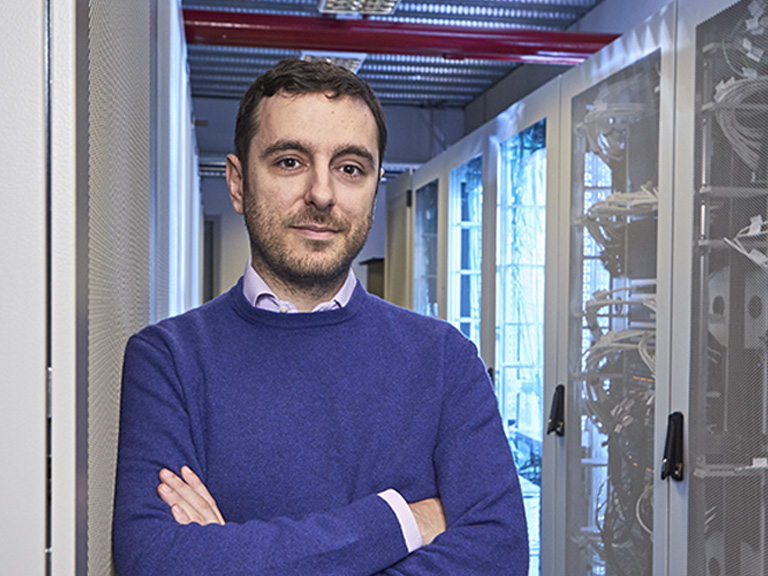
Building quantum defences
Protecting against future cyber threats is essential. Alejandro Montblanch is focused on safeguarding our systems through quantum key distribution.

Upskilling everyone is vital
William Shoosmith explains why it is critical that the whole workforce is equipped with the right skills for the quantum era.
Strategic partnerships
Our collaborations with industry leaders, academic institutions and quantum startups are crucial to remaining at the cutting edge of innovative developments.
HSBC Quantum Singapore Centre of Excellence
Read about how we’ve partnered with the Monetary Authority of Singapore and local banks in Singapore to advance quantum technologies in financial services.
Leading the way
We’re working with Quantinuum to apply quantum technologies and post-quantum cryptography to financial innovation, including the first application for tokenised physical gold.
Quantum secure finance
Together with BT and Toshiba, we became the first bank to join the London Quantum Secure Metro network and trial quantum key distribution to safeguard financial transactions and data.
Research and development
We are active contributors to scientific research in quantum technology, with a growing portfolio of intellectual property.
- Cryptographic Inventory: Delivering Value Today, Preparing for Tomorrow (opens in new window) [June 2025]
- Training Hybrid Deep Quantum Neural Network for Efficient Reinforcement Learning (opens in new window) [Mar 2025]
- Undecidable problems associated with variational quantum algorithms (opens in new window) [Mar 2025]
- Identifiability of Controlled Open Quantum Systems (opens in new window) [Dec 2024]
- Entanglement scaling in matrix product state representation of smooth functions and their shallow q… (opens in new window) [Dec 2024]
- Evidencing Dissipation Dilution in Large-Scale Arrays of Single-Layer WSe2 Mechanical Resonators (opens in new window) [Nov 2024]
- Quantum Monte Carlo Integration and Simulation-based Optimisation (opens in new window) [Oct 2024]
- Challenges and opportunities in quantum optimization (opens in new window) [Oct 2024]
- Asset tokenisation in the Quantum Age (opens in new window) [Sep 2024]
- Effects of the entropy source on Monte Carlo simulations (opens in new window) [Sep 2024]
- Multichannel photoionization of cold strontium atoms (opens in new window) [Sep 2024]
- Spectral Methods for Quantum Optimal Control: Artificial Boundary Conditions (opens in new window) [Mar 2024]
- Magneto-optical trap reaction microscope for photoionization of cold strontium atoms (opens in new window) [Feb 2024]
- Quantum Multiple Kernel Learning in Financial Classification Tasks (opens in new window) [Dec 2023]
- Predicting Ising Model Performance on Quantum Annealers (opens in new window) [Nov 2023]
- Parallel variational quantum algorithms with gradient-informed restart to speed up optimisation in … (opens in new window) [Nov 2023]
- Configured Quantum Reservoir Computing for Multi-Task Machine Learning (opens in new window) [Oct 2023]
- Reinforcement Learning for Gate Synthesis in Noisy Quantum Systems (opens in new window) [Sep 2023]
- Approaching Collateral Optimization for NISQ and Quantum-Inspired Computing (opens in new window) [May 2023]
- Anomalous loss behavior in a single-component Fermi gas close to a p-Wave Feshbach resonance (opens in new window) [May 2023]
- Preparing for a Post-Quantum World by Managing Cryptographic Risk (opens in new window) [Mar 2023]
- A Survey of Quantum Alternatives to Randomized Algorithms: Monte Carlo Integration and Beyond (opens in new window) [Mar 2023]
- Emergent Order in Classical Data Representations on Ising Spin Models (opens in new window) [Mar 2023]
- Entropic DDoS Detection for Quantum Networks (opens in new window) [Nov 2022]
- Measurements of Dipole Moments for the 5s5p3P1–5sns3S1 Transitions via Autler-Townes Spectroscopy (opens in new window) [Aug 2022]
- Globally Optimal Quantum Control (opens in new window) [Sep 2022]
- Transpiling Quantum Circuits using the Pentagon Equation (opens in new window) [Sep 2022]
References
- According to Quantum Index and Evident AI
Content last updated: 5 December 2025